
Africa’s efforts to achieve a just energy transition risk being undermined by policies that favour fossil fuel expansion, corporate interests and dependence on external financing, according to a new report by the Corporate Accountability and Public Participation Africa (CAPPA) and the Africa Make Big Polluters Pay Coalition.
The report warns that several African countries are pursuing climate commitments that contradict their continued investment in fossil fuels, raising concerns about whether their energy transition plans will deliver meaningful benefits for local communities.
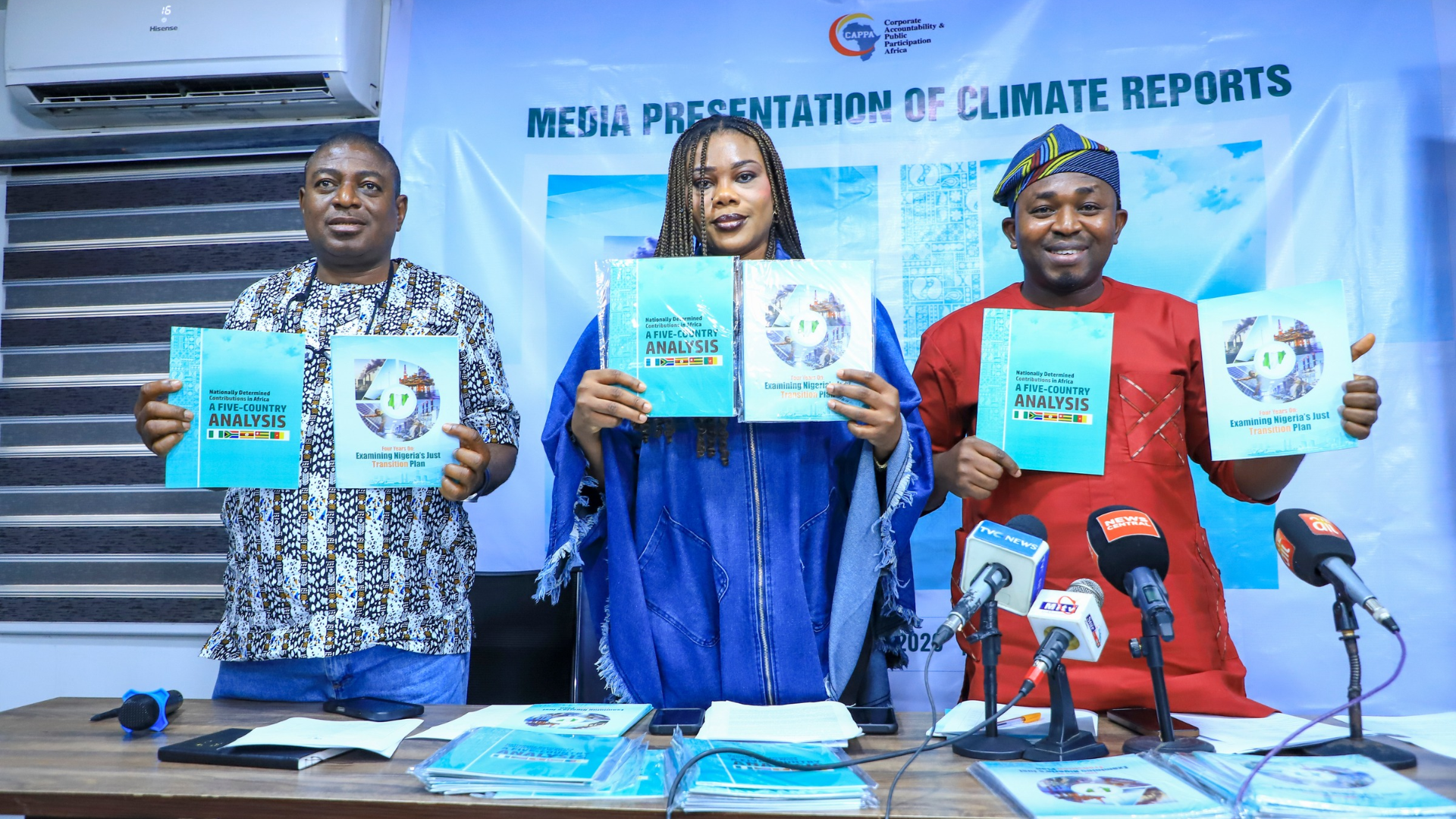
Speaking at the launch of the reports in Lagos on Tuesday, November 10, 2026, Executive Director of South Africa’s Yielding Intersectional Movements Foundation (YIM Foundation), Ndivile Mokoena, said African governments must move beyond ambitious climate promises to practical implementation, adequate financing and support for vulnerable communities.
“The persistent gap between global climate commitments and local realities raises critical questions about political will and economic systems that continue to prioritise profit and growth over human well-being and ecological sustainability,” Mokoena said.
The reports, titled Four Years On: Examining Nigeria’s Just Transition Plan and Nationally Determined Contributions in Africa: A Five-Country Analysis, examine climate policies in Nigeria, Cameroon, South Africa, Togo and Uganda.
They identify contradictions in the countries’ climate plans, including continued fossil fuel expansion, dependence on uncertain international financing and the growing use of carbon markets and offsetting mechanisms.
In Nigeria, the report estimates that about 337 billion dollars will be required to implement the country’s climate commitments between 2026 and 2035, with 80% of the funding expected from international sources.
It also highlights a contradiction between Nigeria’s ambition to achieve net-zero emissions by 2060 and its official target of increasing crude oil production to three million barrels per day by 2030.
The analysis raises concerns about climate financing arrangements in other countries. Togo, for instance, has made 69.9% of its climate financing conditional on international support, while about 80% of South Africa’s recorded international climate support in 2021 and 2022 came in the form of loans.
In Uganda, the report questions the emphasis on commercial tree plantations in projected emissions reductions compared with natural forest restoration.
It also points to continued fossil fuel expansion in Cameroon, where five oil exploration blocks were reported to have entered contract negotiations involving Murphy West Africa and Octavia Energy.
For Nigeria, the report says the energy transition must also address the country's electricity access challenges, citing World Bank figures indicating that more than 80 million Nigerians lacked access to electricity.
Executive Director of CAPPA, Akinbode Oluwafemi, said a just transition should be measured by improvements in people's lives, protection of livelihoods and respect for community land rights, rather than changes in energy sources or the announcement of ambitious targets.
“A just transition must mean more than changing energy sources or announcing ambitious targets. It must improve people’s lives, protect livelihoods, respect community land rights, and ensure that those responsible for the climate crisis meet their obligations,” Oluwafemi said.
The report launch also raised concerns about foreign corporate influence on national climate policies, with Olamide Martins stressing that African countries must ensure their climate commitments reflect local priorities and development realities.
The reports recommend that African governments reject carbon offsetting as a substitute for direct emissions reductions, pursue grant-based climate financing and reparations, protect community land rights and increase investment in renewable energy.
They also call for a planned reduction in dependence on fossil fuels, alongside measures to protect workers and communities affected by the transition.
The coalition says Africa’s energy transition must be shaped by the needs of its people and should not become another avenue for advancing corporate interests or placing additional financial burdens on developing economies.

Comments
Add a comment