

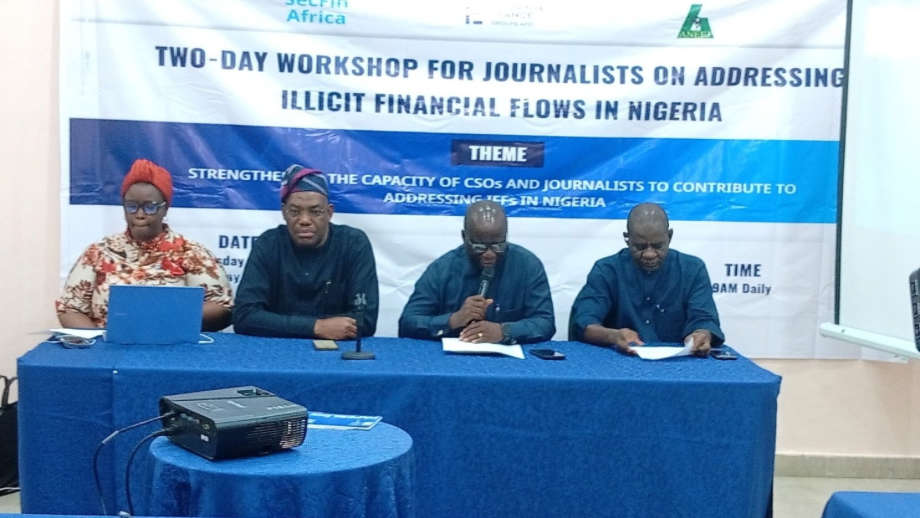
The Nigeria Financial Intelligence Unit (NFIU) has urged journalists to strengthen investigative reporting to help expose corruption, money laundering and illicit financial flows.
The call came during a two-day capacity-building workshop for journalists and media practitioners organised by the African Network for Environment and Economic Justice (ANEEJ) with support from the European Union through the SecFin Africa Programme.
The workshop, held in Lagos, is part of the project, "Strengthening CSOs and Media Capacity to Contribute to the Fight Against Illicit Financial Flows (IFFs) in Nigeria," which aims to equip journalists with the skills to investigate and report financial crimes while promoting transparency and public accountability.
Head of Strategic Communications at the NFIU, Aisha Bantam, said the media plays a critical role in promoting transparency, holding institutions accountable and informing citizens on the impact of financial crimes on national development.
She said every illicit financial outflow represents lost opportunities, including unbuilt infrastructure, weaker social services and reduced economic growth.
According to her, financial crimes have become increasingly sophisticated, with criminals exploiting technology, complex ownership structures and cross-border systems to conceal proceeds of crime.
Bantam said investigative journalism has contributed to major global revelations on corruption, money laundering, tax evasion and organised crime, adding that responsible reporting can strengthen institutions and drive policy reforms.
She said the NFIU remains committed to providing financial intelligence that supports investigations into corruption, terrorism financing, cybercrime, kidnapping proceeds and other serious offences, while stressing the need for stronger collaboration between government agencies, the private sector and the media.
Meanwhile, Executive Director of ANEEJ, David Ugolor, urged journalists to build stronger capacity in reporting financial crimes and follow the money behind corruption cases.
He said illicit financial flows undermine development by affecting infrastructure, social protection and public trust, urging journalists to use investigative tools, strengthen professional networks and produce evidence-based reports that promote accountability and good governance.
Also speaking, a representative of SecFin Africa, Prof. Abdullahi Shehu, said the media must go beyond raising awareness to educating the public on preventing illicit financial flows and supporting investigative journalism.
He urged journalists to expose illicit financial flows by identifying where they occur and those responsible, noting that the crime weakens Nigeria's economy by reducing revenue for development, undermining investor confidence and putting pressure on the country's foreign exchange.
Shehu said participants at the two-day workshop would be trained on the sources, typologies, manifestations and economic impact of illicit financial flows to strengthen media reporting.
He also encouraged journalists to make greater use of the Freedom of Information Act to obtain public records and hold government institutions accountable for implementing recommendations aimed at tackling illicit financial flows.

Comments
Add a comment