
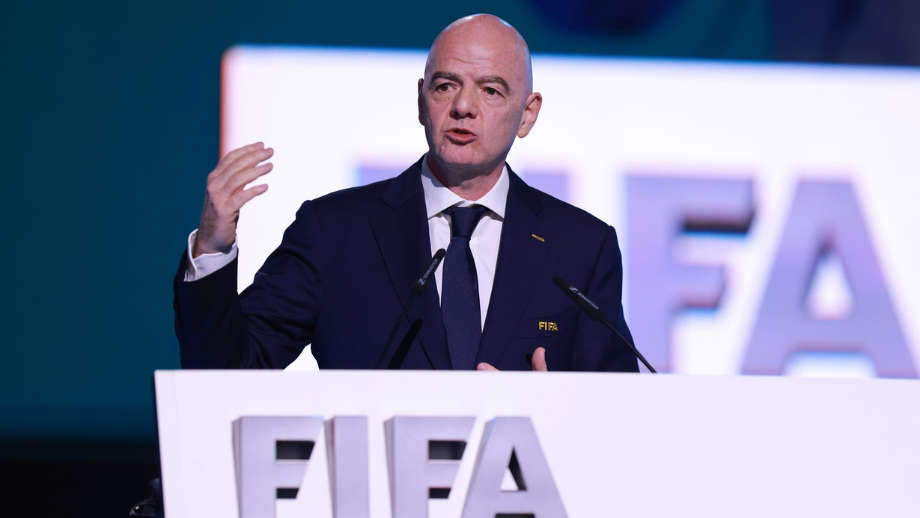
FIFA President Gianni Infantino says Nigeria is not currently ready to host the senior FIFA World Cup, pointing to gaps in stadium infrastructure, airports, hotels and transportation networks.
However, he believes the country has the resources, football passion and potential to work towards hosting the competition in the future.
Infantino made the remarks during an exclusive interview with ARISE News in Abuja on Monday, November 23, when asked whether Nigeria could host a tournament of the World Cup's magnitude.
"Today, no. But tomorrow, why not?" He said.
The FIFA president explained that hosting the World Cup requires more than a strong football culture. Countries must have the infrastructure to accommodate national teams, officials, supporters, media representatives and the large number of visitors attracted by the competition.
"The key to hosting a World Cup is obviously the infrastructure, the stadiums, the airports, transportation, and this is where the best practice is needed," Infantino said.
He added that Nigeria had the resources, passion and determination to pursue the ambition, particularly through the stadium projects already planned across the country.
Infantino's assessment comes shortly after his visit to Nigeria, where he inspected football infrastructure projects in Delta State and Abuja alongside FIFA Secretary-General Mattias Grafström.
His first major stop was Warri City Stadium, where he was received by Delta State Governor Sheriff Oborevwori and inspected the renovated multi-purpose facility.
The stadium has undergone extensive improvements, including a hybrid-grass football pitch, a nine-lane athletics track, an Olympic-sized swimming pool, an indoor sports hall, modern floodlights and upgraded changing rooms.
Infantino described the rehabilitated stadium as a symbol of hope and opportunity for young people in the region, commending the Delta State Government and the Nigeria Football Federation for their commitment to football development.
He also visited the ongoing FIFA Forward Technical Centre project at the Moshood Abiola National Stadium in Abuja. The project, which received $4.88 million in funding under FIFA's Forward 3.0 programme, is being developed in collaboration with the NFF.
When completed, the facility is expected to include a 68-room players' hostel, two training pitches, dressing rooms, accommodation and other facilities to support Nigeria's men's and women's national teams.
Infantino described the project as an important investment in the future of Nigerian football, particularly in creating opportunities for young boys and girls to develop their talents
The FIFA president was also in Abuja for the 48th CAF Ordinary General Assembly on Saturday, November 21, which brought together representatives of the Confederation of African Football's 54 member associations.
During the gathering, CAF President Patrice Motsepe announced the confederation's support for Infantino's re-election as FIFA president. Infantino also outlined plans under the proposed FIFA Forward 4.0 programme to increase funding for each member association from $8 million to $25 million over four years, subject to approval by the FIFA Council.
Nigeria has never hosted the senior men's FIFA World Cup, although it staged the FIFA U-17 World Cup in 2009.
The Golden Eaglets reached the final of that tournament but lost 1-0 to Switzerland at the National Stadium in Abuja.
South Africa remains the only African country to have hosted the senior men's World Cup, making history in 2010. Morocco is scheduled to become the second African host when it co-hosts the 2030 edition with Spain and Portugal. Uruguay, Argentina and Paraguay will also stage centenary matches.
Infantino's comments do not rule out a future Nigerian bid, but they underline the scale of investment required before the country can realistically compete to host the tournament.
For now, Nigeria's immediate challenge is to complete and maintain its football infrastructure projects, improve transport and hospitality facilities, and develop the capacity to stage major international competitions.
Comments
Add a comment