
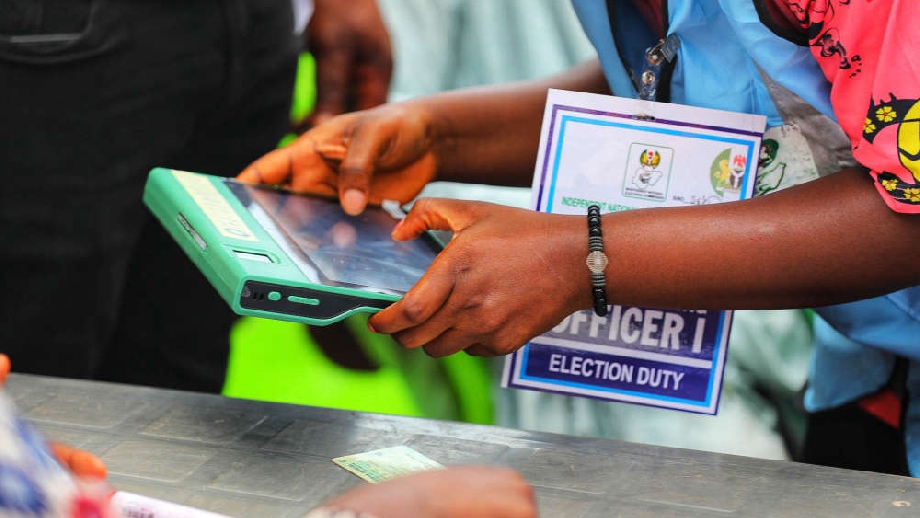
The nationwide mock accreditation and voting exercise organised by the Independent National Electoral Commission (INEC) recorded low voter turnout in parts of Lagos State, raising concerns about public interest in the 2027 general elections.
The exercise, held on Saturday, November 28, was designed to test the commission's election technology, particularly the Bimodal Voter Accreditation System (BVAS) and electronic transmission of results to the INEC Result Viewing Portal (IReV).
However, reports from polling units in different parts of Lagos suggest that many eligible voters did not turn up, despite INEC's invitation to participate.
Low Turnout Raises Concerns in Lagos
In Ijegun, Satellite Town and Festac, in the Amuwo-Odofin area of Lagos, polling agents reported poor participation.
According to a report by Vanguard, an INEC polling agent at one of the locations said only about 40 of the 250 registered voters had participated as of the time of the newspaper's visit.
Some voters and political party representatives blamed the situation on inadequate publicity, arguing that many residents did not know the exercise was taking place.
The situation was also noticeable in Somolu, where reporters observed that accreditation and mock voting were proceeding normally, but participation remained low.
At the polling units, voters were given mock ballot papers bearing the names of colours instead of political parties.
These included Blue, Red, Navy and Pink parties.
The process was scheduled to end at 2:30 p.m., after which polling officers would complete result sheets and upload them to IReV.
There were also allegations of coordinated voting at some polling units.
Or reporters observed instances where voters appeared to have been directed to vote for particular colours.
Further checks suggested that the colours assigned to some voters corresponded with the positions of certain political parties on the actual ballot paper.
A ward representative of another political party, who chose to remain anonymous, questioned the arrangement, alleging that it contradicted agreements reached at a stakeholders' meeting.
He also accused some participants of colluding with INEC, although the allegation has not been independently established.
Accreditation Smooth in Surulere
In Surulere, the exercise was described as peaceful.
Polling officers at the polling unit visited by our reporter said residents turned out to participate, although some encountered difficulties during accreditation.
A first-time polling officer, Ismail Omoyemi, described the BVAS accreditation system as easy to operate, adding that even people with limited computer knowledge could use it after a brief explanation.
Another polling officer, Johnson Abosede, said some residents could not participate because their voter information was registered under different polling units.
She explained that the BVAS could only identify voters assigned to the particular polling unit.
Those affected were advised to visit their designated polling units during the actual elections.
Abosede also reported cases of residents who claimed to have registered but whose details were unavailable on the machines because their Permanent Voter Cards (PVCs) had not been issued.
She said the observations would be communicated to INEC officials for attention before the general elections.
The exercise involved testing voter accreditation and casting dummy votes for the House of Assembly.
The Divisional Police Officer of the Bode Thomas Police Division, CSP Kola Ogundipe, also visited the location.
INEC's Preparations and IReV Test
INEC had announced that the exercise would take place in two polling units in each of Nigeria's 8,838 Registration Areas, covering 17,676 polling units nationwide.
In Lagos, the exercise was scheduled for 490 polling units across 245 Registration Areas.
INEC Chairman, Professor Joash Amupitan, said the exercise would test whether the commission had got accreditation and electronic result transmission right.
He also disclosed that INEC had procured 57,000 new BVAS devices and reduced the maximum number of voters assigned to each machine from 1,250 to 850.
The commission has also introduced new safeguards designed to prevent inaccurate results and figures showing over-voting from being uploaded to IReV.
Amupitan acknowledged that the controversies surrounding the 2023 general elections had created a significant trust deficit for INEC, saying the commission had not fully recovered from the damage.
A check of INEC's online results dashboard during the exercise showed that one result had been uploaded each for the presidential and senatorial mock exercises, while the House of Representatives mock exercise still showed zero uploads.
The dashboard listed 17,704 expected results for each category.
This suggests that result uploads were still at an early stage at the time of the check.
A Costly Exercise and a Warning for 2027?
Beyond the technical results, the poor turnout raises questions about the public's willingness to participate in the electoral process.
Although INEC has not published the total cost of the mock exercise, organising a nationwide test across thousands of polling units requires money for personnel, equipment, transportation, logistics and security.
When citizens fail to participate in an exercise designed to prepare the country for an important democratic process, some of the resources committed to it may not deliver their full value.
The concern is even greater when the exercise is considered against Nigeria's history of low voter participation.
According to INEC's report on the 2023 general elections, only 25.3 million of the 93.4 million registered voters were accredited, representing about 27 per cent of registered voters.
While a mock exercise is different from an actual election, the poor participation recorded in parts of Lagos could be an early warning of the apathy that may affect the 2027 polls.
Comments
Add a comment