

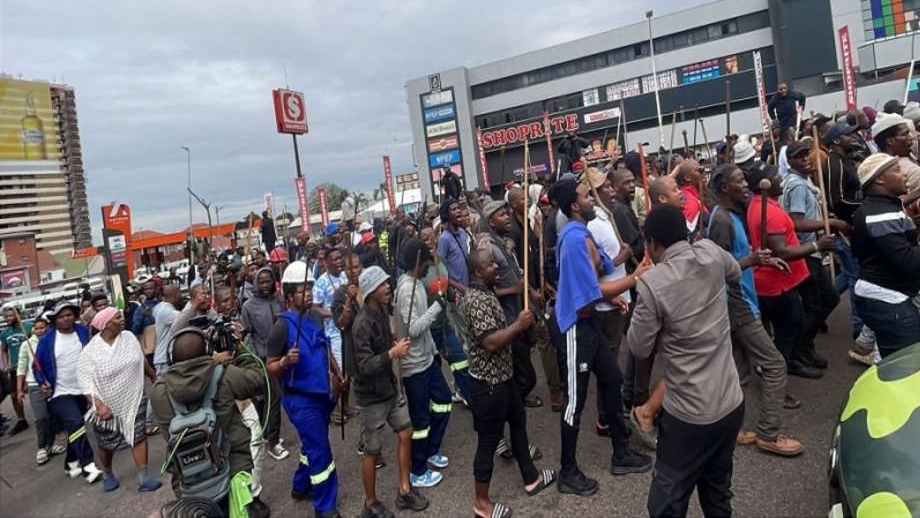
Anti-immigration protests began across South Africa on Tuesday as the June 30 deadline issued by pressure group March and March for undocumented migrants to leave the country took effect.
Demonstrators gathered in several locations under heavy security, with police and other security agencies deployed across Gauteng, KwaZulu-Natal and the Western Cape to prevent violence and maintain public order.
The South African government distanced itself from the ultimatum, insisting that immigration enforcement remains the responsibility of state authorities.
President Cyril Ramaphosa urged protesters to demonstrate peacefully and avoid intimidation, threats or violence.
In his weekly newsletter, Ramaphosa acknowledged the need for immigration reforms but stressed that many foreign nationals live in South Africa legally.
“Some foreign nationals living in South Africa are here lawfully. They work, study, raise families, invest in our economy and contribute positively to our society. They are entitled to the protection of our laws and Constitution,” he said.
He added that the right to protest does not permit acts of violence, vandalism or intimidation.
Security was heightened in major cities, including Johannesburg and Durban, where businesses in several areas remained shut as a precaution.
Police said five people were arrested in Soweto for allegedly looting a foreign-owned shop, while another five suspects were arrested over a break-in at a tuck shop in Hammarsdale, KwaZulu-Natal.
In Durban, authorities dismantled temporary tents housing mainly Malawian nationals as officials accelerated efforts to repatriate migrants. Many displaced residents queued to board buses returning to Malawi.
One migrant, Nelson Mbewe, said he travelled to South Africa in search of work to support his family but decided to return after facing challenges over his immigration status.
Authorities approved protest marches in Durban, Johannesburg and other cities but warned organisers against allowing violence or public disorder.
Police also prohibited protesters from carrying traditional weapons such as shields, sticks and whips, raising concerns about possible confrontations with demonstrators.
According to the South African government, more than 12,000 undocumented immigrants have been deported or repatriated since anti-immigration operations intensified earlier this year.
Several African countries, including Ghana, Malawi, Mozambique, Nigeria and Zimbabwe, have also organised voluntary repatriation programmes, with about 3,500 migrants returning home by air or road in recent weeks.
South African authorities have claimed that more than 500 repatriated Nigerians lacked valid immigration documents, an assertion the Nigerian government has disputed.
Official figures show that more than three million documented foreign nationals currently reside in South Africa, although authorities believe many more undocumented migrants remain in the country.
Thousands of migrants have been staying in temporary camps while awaiting processing and transportation home amid fears of attacks.
South Africa has experienced repeated outbreaks of xenophobic violence over the years. According to the African Centre for Migration and Society’s Xenowatch tracker, two people have been killed in xenophobic incidents this year. In 2008, more than 60 people died during widespread anti-foreigner attacks.

Comments
Add a comment