

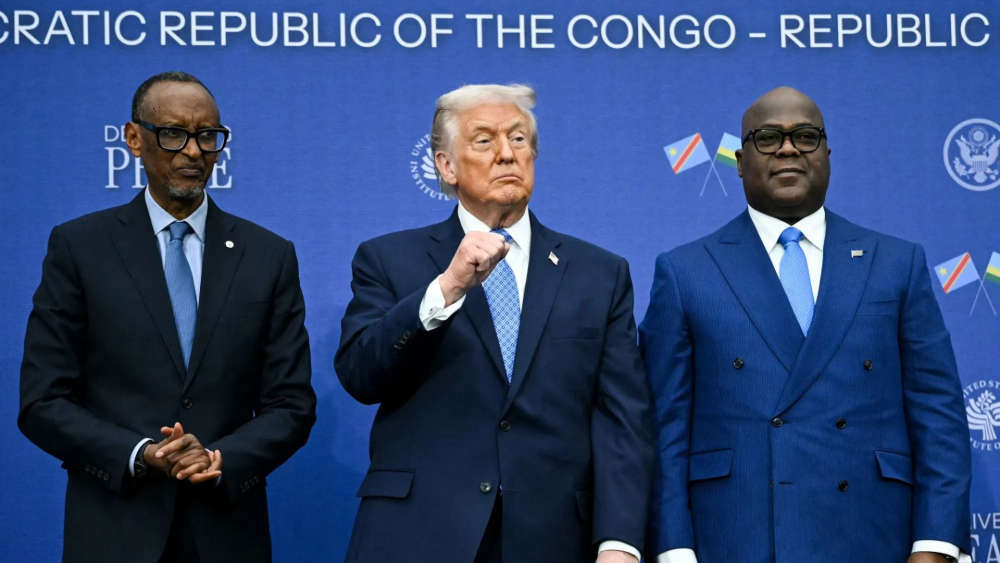
The presidents of the Democratic Republic of Congo (DRC) and Rwanda formally signed a sweeping, U.S.-brokered peace and economic agreement Thursday, dubbed the “Washington Accords,” aimed at ending decades of deadly conflict in the resource-rich eastern Congo.
The ceremony, hosted by U.S. President Donald Trump, saw DRC President Felix Tshisekedi and Rwandan President Paul Kagame commit to a framework designed to foster peace, security, and economic cooperation, particularly concerning the region’s vast critical mineral reserves.
The deal formalizes a preliminary pact signed in June 2025.
The signing, however, was overshadowed by reports of continued fighting in the eastern DRC between the Congolese army and the Rwanda-backed M23 rebel group.
Critics and analysts immediately expressed skepticism about the agreement’s immediate impact, given the history of failed peace deals and the M23’s continued offensive, which has displaced millions.
President Kagame, acknowledging the fragility of the moment, stated that the responsibility for success lies squarely with the two nations.
“If this agreement falters and things do not work out as they are supposed to, the responsibility will not lie with President Trump, but with ourselves,” Kagame said, calling the US-led effort the “clearest and most viable path forward that we have ever had.”
President Tshisekedi’s delegation, while calling the accord a “historic opportunity,” has simultaneously accused the rebels of trying to “sabotage” the peace process on the ground.
Security and the Economy
The Washington Accords address core security and economic issues driving the conflict.
The deal commits Rwanda to withdraw its troops from the eastern DRC and for the DRC government to end support for the Democratic Forces for the Liberation of Rwanda (FDLR) militia, a group Rwanda views as an existential threat.
A joint security coordination mechanism is to be established within 30 days.
The agreement also includes a Regional Economic Integration Framework (REIF), designed to unlock the Great Lakes region's economic potential, focusing on the trade and processing of critical minerals.
Concerns over Exploitation
President Trump explicitly stated the deal opens a pathway for U.S. companies to access the region’s tremendous mineral wealth, including cobalt, gold, and rare-earth minerals, with the promise that “everybody is going to make a lot of money.”
The Accords reaffirm the parties’ commitment to respecting sovereignty and territorial integrity, a key demand of the DRC, which has long accused Rwanda of backing the M23 to control its mineral resources.
The principal challenge remains implementation. The M23 rebel group is not a direct signatory to the agreement, and past deals have collapsed due to disputes over the sequencing of troop withdrawals and the disarmament of non-state groups.
The US has also signed separate bilateral instruments, including a Strategic Partnership Agreement with the DRC and a Framework for Shared Economic Prosperity with Rwanda, signaling a significant commitment to monitor and facilitate the accord’s progress.
The complex interplay between the security commitments and the mineral trade framework remains a contentious issue that will define the accord’s eventual success or failure.