
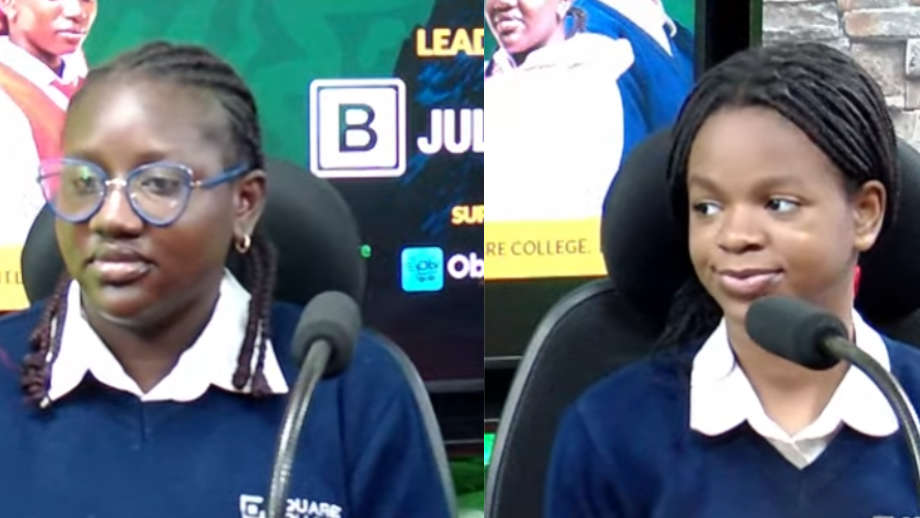
Square College, Lagos has secured the final semi-final spot in Season Nine of the I Beg To Differ National Schools Debate Championship after defeating Silverbird International School, Port Harcourt, in a closely contested quarterfinal debate.
The two schools battled on the motion, “Morality Exists Without Religion,” with Square College defending the proposition that morality can exist independently of religious belief, while Silverbird International School argued that religion provides the foundation and authority necessary for morality.
Square College eventually prevailed with 80.3 points to Silverbird International School’s 74.7 points, securing a unanimous victory after all three adjudicators and the audience vote placed the Lagos school ahead.
Opening the debate, Square College argued that human beings can develop moral principles through empathy, reason, cooperation and concern for others without relying on religious instruction.
The school cited examples such as returning a lost phone, helping a neighbour with medical bills and rejecting examination malpractice as actions that demonstrate honesty, care and fairness, which it argued can arise from human relationships and shared responsibility.
Square College also referred to research on children's behaviour to argue that helpfulness can emerge before formal religious instruction, while stressing that Nigeria's religious diversity makes it necessary for public morality to accommodate people from different faiths as well as those without religious beliefs.
The school further challenged the idea that religion is the sole source of morality through the philosophical question known as the Euthyphro dilemma, asking whether something is good because God commands it or whether God commands it because it is already good.
In response, Silverbird International School argued that people’s ability to behave well without religion does not necessarily establish the existence of an objective moral standard.
The Port Harcourt school maintained that the central question was not whether non-religious people could be kind, honest or compassionate, but what gives moral rules their authority and makes them binding even when individuals or societies disagree.
It argued that society, personal feelings and majority opinion can change, making them insufficient foundations for objective morality.
Silverbird also cited religious belief in Nigeria and philosophical arguments surrounding divine command theory to support its position that religion provides a higher authority for determining right and wrong.
During the rebuttal round, the opposition challenged Square College to explain what makes an action objectively good if morality is based on human empathy, reason or society.
Square College, however, maintained that moral behaviour can be grounded in civic responsibility, justice, conscience and human cooperation without religion.
The school also argued that religious traditions themselves have differed over issues such as punishment, war, gender and human rights, insisting that moral reasoning is still required to determine whether a religious practice is just or fair.
In the closing round, Square College stressed that human beings lived in communities and depended on cooperation, trust and care long before the emergence of organised religious systems.
The school invoked the Southern African philosophy of Ubuntu, centred on interconnectedness and shared humanity, to argue that moral responsibility can develop from human relationships and communal life.
Silverbird, in its final submission, maintained that its opponents had demonstrated only that people could behave morally without religion, but had not answered the deeper question of what makes morality binding.
It argued that governments, societies, majorities and individual feelings could all be wrong or change over time, while religion provides what it described as a higher authority for distinguishing right from wrong.
The adjudicators commended both teams for clearly defining their terms at the beginning of the debate, while advising the students to improve their delivery and engagement with the audience.
The adjudicators' scores showed a consistently strong performance from Square College across the three rounds.
The cumulative adjudicators' scores gave Square College 74 points, compared with 71 points for Silverbird International School, before the audience vote was added.
Square College then secured 63 percent of the audience vote, against Silverbird's 37 percent, taking its final score to 80.3 points, while Silverbird finished on 74.7 points.
The result places Square College Lagos in the semi-finals alongside Grace High School, Government Day Secondary School and Fountain School Jikwoyi, Abuja.
Square College is scheduled to face Fountain School Jikwoyi, Abuja, in the second semi-final on Monday.
Silverbird International School, which entered the national competition after finishing as third runners-up at the Port Harcourt regional finals, exits the championship at the quarterfinal stage and receives ₦250,000.
The quarterfinals have now produced the final four schools in contention for the Season 9 title, with the semi-finals set to feature Lagos against Abuja in both fixtures.

Comments
Add a comment