

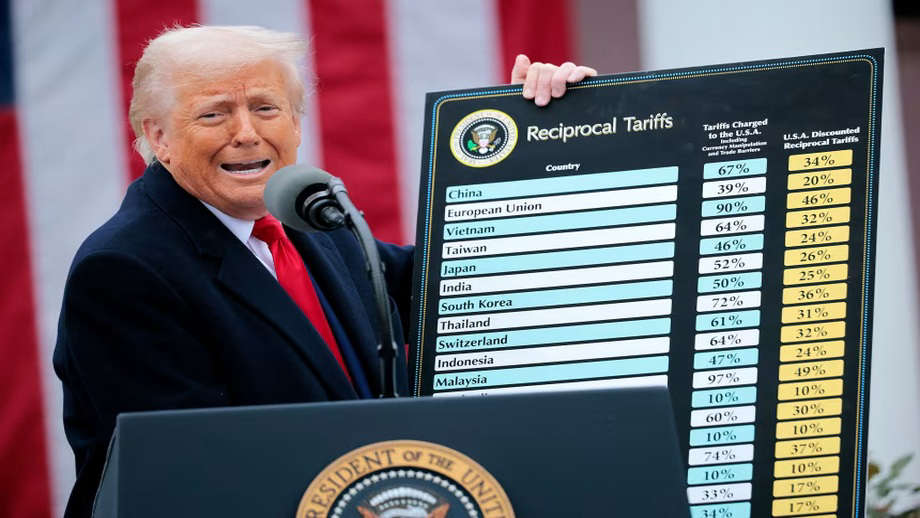
The U.S. Supreme Court on Friday ruled that former President Donald Trump violated federal law by unilaterally imposing sweeping tariffs under emergency powers, dealing a major blow to a signature part of his economic agenda.
In a 6-3 decision, the court said the International Emergency Economic Powers Act (IEEPA) does not give the president authority to impose tariffs without clear congressional approval.
Chief Justice John Roberts, writing for the majority, said Trump’s claimed powers were too broad.
“The president asserts the extraordinary power to unilaterally impose tariffs of unlimited amount, duration, and scope,” Roberts wrote. “He must identify clear congressional authorization to exercise it.”
Justices Amy Coney Barrett and Neil Gorsuch joined Roberts and the three liberal justices in the majority. Dissenting were Justices Clarence Thomas, Samuel Alito, and Brett Kavanaugh.
The case focused on Trump’s “Liberation Day” tariffs and other duties on imports from China, Mexico, and Canada, some as high as 50% and up to 145% on China, which brought in more than $130 billion in revenue.
The court did not rule on what should happen to the roughly $134 billion already collected, saying that issue falls to lower courts. Roberts emphasized the judiciary’s role is limited to interpreting the law, not economic or foreign policy decisions.
In dissent, Kavanaugh warned that determining refunds could be messy, leaving questions for lower courts to handle.
Trump had argued that IEEPA, enacted in the 1970s to allow presidents to regulate imports during national emergencies, gave him the power. Opponents, including small businesses and importers, argued the law does not mention tariffs, and such action requires explicit congressional approval.
The decision marks one of Trump’s biggest legal setbacks at the Supreme Court, which had previously sided with him on emergency immigration, agency leadership, and federal spending cases.