

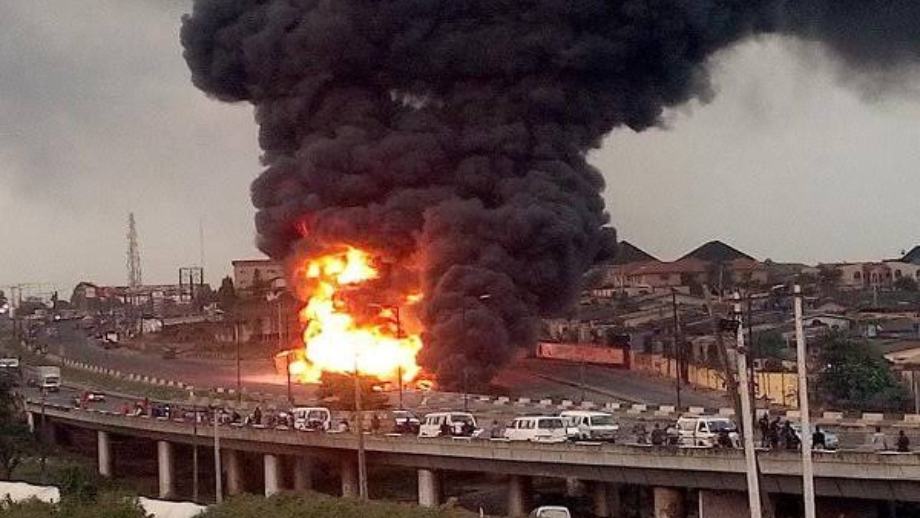
Otedola Bridge on the Lagos-Ibadan Expressway has become one of Lagos’ most feared routes because of repeated road crashes, including fatal collisions, tanker fires and accidents involving heavy-duty trucks.
The latest incident occurred Monday, Oct. 19, 2026, when a diesel-laden tanker plunged from the bridge and caught fire, leaving two people with severe burn injuries.
The Federal Road Safety Corps (FRSC) blamed speeding for the crash, renewing concerns about safety on one of Lagos’ busiest traffic corridors.
According to the FRSC Lagos Sector Command, the accident happened at about 4:10 p.m. on the outward section of the expressway.
The agency’s Sector Public Education Officer, Elizabeth Jayeola, said the tanker plunged into the underpass beneath the bridge, triggering a fire.
The FRSC said its rescue team arrived at the scene at 4:20 p.m., five minutes after receiving the report.
The Lagos State Traffic Management Authority (LASTMA) said the two victims sustained severe burns and were taken to the Lagos State Accident and Emergency Centre at Toll Gate.
LASTMA’s Director of Public Affairs and Enlightenment, Adebayo Taofiq, said emergency responders had “swiftly mobilised to the scene and successfully rescued the two severely burnt victims.”
The agency urged heavy-duty vehicle operators to conduct regular mechanical inspections, follow safety regulations and drive responsibly.
A Timeline of Reported Accidents
The latest incident follows several crashes recorded on or around the bridge over the past three years.
Here is a timeline of selected reported incidents.
- Sept. 12, 2023: A wheat-laden truck fell from the bridge, killing one occupant.
- May 24, 2024: Lagos State Ambulance Service records documented a fatal hit-and-run incident near Otedola Bridge. The service’s record said responders found a corpse when they arrived.
- Jan. 7, 2025: Four articulated trucks were involved in a series of crashes around the bridge. One person died, and three others were injured.
- March 11, 2025: A gas-laden truck fell and exploded, damaging vehicles and nearby buildings. The National Emergency Management Agency initially reported one death and four injuries, while later reports put the death toll at two.
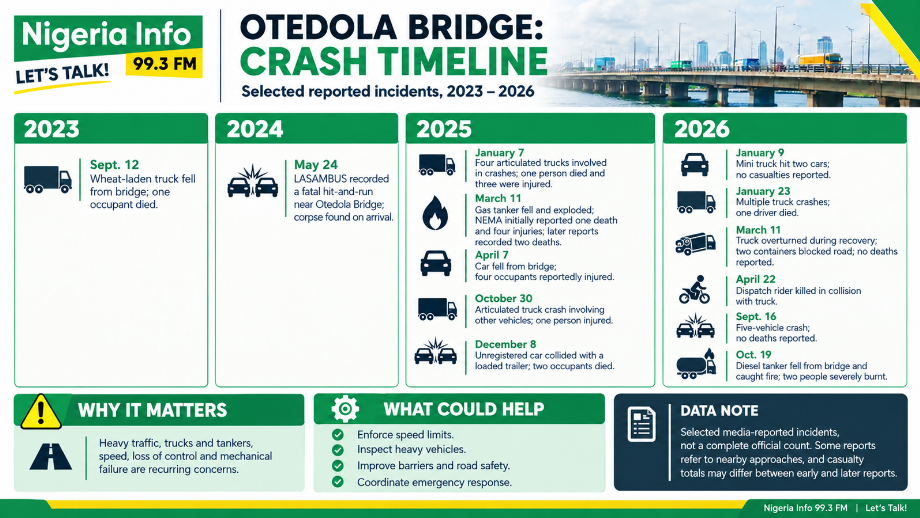
- April 7, 2025: A car fell from the bridge, with reports indicating that its four occupants were injured.
- Oct. 30, 2025: An articulated truck reportedly suffered brake failure and crashed into other vehicles, leaving one person injured.
- Dec. 8, 2025: Two occupants of an unregistered vehicle died after it collided with a heavily loaded trailer at Otedola Bridge, inward Berger. The trailer driver reportedly fled the scene.
- Jan. 9, 2026: A mini truck rammed into two cars. No casualties were reported.
- Jan. 23, 2026: Multiple crashes involving heavy-duty trucks killed one driver and caused severe traffic congestion.
- March 11, 2026: A truck overturned during a recovery operation, spilling two containers onto the road and causing major traffic disruption. No deaths were reported in that incident.
- April 22, 2026: A dispatch rider died after a collision with a heavy-duty truck at Otedola Bridge, inward Secretariat.
- Sept. 16, 2026: Five vehicles were involved in a crash. No deaths were reported.
- Oct. 19, 2026: A diesel tanker fell from the bridge and caught fire, severely burning two people.
What Has the Government Done?
Following the deadly 2018 tanker explosion on Otedola Bridge, the Lagos State Government announced restrictions on tanker movements and plans to strengthen roadworthiness checks for heavy-duty vehicles.
The government also announced plans to install barriers on bridges across Lagos to prevent articulated trucks from falling off them.
However, the repeated accidents raise questions about the effectiveness of these measures and the need for sustained enforcement.
What Needs to Change?
The recurring crashes point to the need for stricter enforcement of speed limits, regular vehicle inspections and effective monitoring of trucks and tankers.
Authorities also need to examine whether bridge barriers, road design, traffic controls and emergency-response arrangements are adequate to prevent vehicles from plunging onto the roads below.
Although emergency agencies have repeatedly rescued victims and cleared accident scenes, preventing crashes before they happen remains the bigger challenge.
For commuters and residents, the central question is whether existing safety measures can be enforced consistently enough to stop another deadly incident.

Comments
Add a comment