

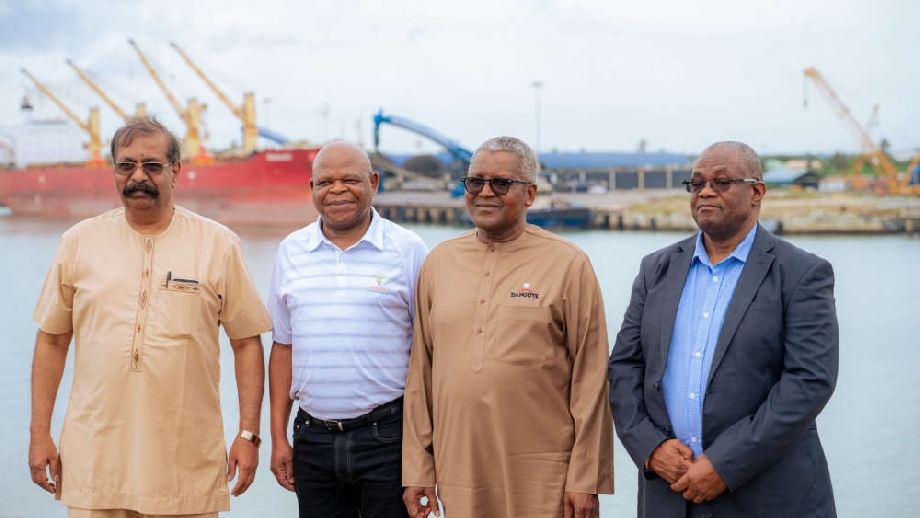
When the Chairperson and Principal Executive Officer of South Africa's Government Employees Pension Fund (GEPF), alongside the CEO and Deputy Chairperson of the Public Investment Corporation (PIC), boarded a flight to Lagos this week, official statements described the trip as a "visit" to the Dangote Petroleum Refinery and Petrochemicals Complex.
That visit was much more than that. It was a commercial exploration ahead of what is shaping up to be the largest IPO in African stock market history. The Dangote Group is preparing to list its refinery, the world's largest single-train petroleum refinery, on the Nigerian Exchange, with a target window of mid-2026. The offering is expected to value the business at between $40 billion and $50 billion. And crucially, it will not stop at the Nigerian Exchange. Five African stock exchanges, including the Johannesburg Stock Exchange, have already sat down with the Nigerian Exchange Group to work out the mechanics of a historic pan-African cross-listing. South Africa's pension savers may not yet know it, but their retirement money could soon be working inside Nigeria's most ambitious industrial project. South Africa's GEPF is Africa's largest pension fund, and the PIC is the continent's biggest asset manager.
"We Are Opening the Doors"
Aliko Dangote was direct about his intentions when he addressed his South African guests. "We are opening the doors for investors to participate directly in Africa's industrial future and the prosperity it will create," he said. He said the planned listing would not be a fundraising exercise but a deliberate effort to widen African ownership of large-scale industrial assets, to ensure that the wealth generated by the continent's industrial transformation stays on the continent. Dangote also made clear that demand has already outpaced expectations. "We thought about Nigeria first and then exports, but even with our current production, we are practically living hand to mouth because the market demand is extremely high," he said, a signal to prospective investors that this is not a speculative bet, but an asset operating in a supply-constrained market. Dangote said the Group’s long-term investment strategy is driven by Africa’s expanding energy needs and the urgent requirement for regional refining capacity capable of serving multiple markets across the continent.
Beyond Africa, the refinery has been crucial to meeting the needs of European markets reeling from geopolitical tensions around the Strait of Hormuz. By early 2026, the refinery was supplying over 62 percent of Nigeria's domestic petrol demand and has begun exporting jet fuel to European airports while shipping refined products to five African countries.
What South Africans Could Own
For South Africa's 1.8 million government employees and pensioners - teachers, nurses, police officers, civil servants - whose retirement savings are managed by GEPF and invested by PIC, the refinery listing presents a rare opportunity. PIC manages approximately $230 billion in assets, largely on GEPF's behalf, and its CEO Patrick Dlamini was unambiguous about where the institution is heading. "PIC's mandate is to deploy long-term, patient capital in service of industrialisation, infrastructure and economic transformation across Africa," Dlamini said after the tour of the Dangote Petroleum Refinery and Petrochemicals Complex. "What we have seen today reinforces our conviction that the next chapter of African prosperity will be written through partnership between African institutional capital and African industrial champions."
GEPF's Chairperson Frans Baleni captured the broader significance of what he witnessed in Lagos. "What has been built here is reshaping how the world should think about African industrial capability, and it should reshape how Africa thinks about itself," he said. "For too long, projects of this magnitude have been associated with other parts of the world."
If PIC takes a position in the IPO, every South African public sector worker in the GEPF scheme gains indirect exposure to a refinery projecting $6.4 billion in annual export revenues. The dividend structure makes this even more attractive: investors will receive dividends paid in US dollars, a deliberate design choice that insulates investors from currency depreciation in both the naira and the rand. The South African delegation included a third player, Alterra Capital Partners, represented by its Managing Partner Genevieve Sangudi. Alterra's presence signals that the opportunity is not limited to pension funds. Private capital vehicles, family offices, endowments, private placement structures, are also circling the offering. For retail South African investors, the JSE cross-listing creates a separate entry point. Rather than opening a Nigerian brokerage account, South Africans may be able to buy into the offering directly through their existing JSE accounts.
The Regulatory Hurdle: Free Float
The JSE cross-listing is not without its complications. South Africa's exchange requires any listed company to maintain a minimum free float of 20 percent, meaning at least one-fifth of shares must be available to the public. Dangote is offering only 5 to 10 percent of the refinery in the IPO, retaining majority control of the asset. That gap created a potential dealbreaker. The proposed solution, according to sources close to the negotiations, is that the JSE listing will proceed via depository receipts rather than direct shares. This structure allows the JSE to waive its free-float rule, giving South African investors a legitimate and regulated pathway into the offering without requiring Dangote to dilute his ownership beyond what he is prepared to offer.
It is a workable compromise, but it also illustrates the broader challenge facing pan-African capital market integration. Each exchange operates under its own rules, and the Dangote IPO is functioning as a live stress test of whether African markets can harmonise fast enough to accommodate a deal of this magnitude.

Comments
Add a comment