

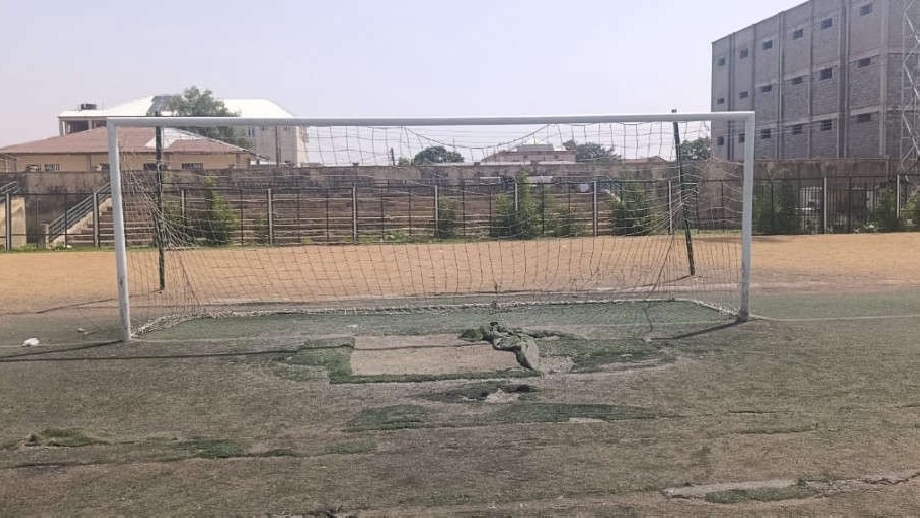
Once regarded as one of Kano's finest sporting facilities, the 10,000-capacity Kano Township Stadium in Sabon Gari has become a symbol of neglect, despite government budgetary allocations for its renovation over the years.
An investigation by Nigeria Info found that the deteriorating condition of the stadium has forced Kano's home team, Kano Pillars, to relocate its matches to the Sani Abacha Stadium in Kofar Mata, while many grassroots football teams have abandoned the facility altogether over safety concerns.
The decline of the stadium comes at a time when countries continue to invest heavily in sporting infrastructure to develop young talents.
In Kano, however, a facility that once nurtured generations of footballers now sits largely abandoned.
Unsafe Pitch Driving Players Away
When Nigeria Info visited the stadium on France Road, Sabon Gari, the artificial turf showed extensive tears, worn-out patches, and clear signs of prolonged neglect.
Parts of the spectators' stand were overgrown with grass, while the changing rooms also appeared poorly maintained. The overall condition suggested that routine maintenance had been absent for years.
Players who spoke with Nigeria Info and Wazobia FM described the pitch as dangerous.
An amateur footballer with Tudun Wada United FC, Ghaddafi Muhammad, said many footballers now avoid playing at the stadium because of the risk of injury.
"The playing surface is littered with holes, exposed metal objects and stones. Any player who falls during a match risks serious injury," he said.
According to him, several teams now prefer to play on community fields with sandy or hard surfaces rather than use the Sabon Gari Stadium.
Coach Anas Muhammad shared similar concerns, describing the facility as a shadow of its former self.
"Football has always been a source of pride for Kano State. This stadium produced many outstanding players, but today athletes refuse to play there because of the dangerous condition of the pitch," he said.
A Stadium Losing Relevance
The Kano Township Stadium last hosted a major professional league match in 2019 when the former League Management Company approved it for two Nigeria Professional Football League fixtures.
Since then, the stadium has mainly been used for grassroots tournaments, novelty matches and other local sporting events.
Sports stakeholders believe the deteriorating condition has contributed to Kano relying heavily on the Sani Abacha Stadium and, at times, facilities outside the state for sporting competitions.
Stakeholder Abdullahi Y. Abdullahi said Kano's football heritage deserves better infrastructure.
"Kano has countless talented young footballers. We should not be sending teams to places like Danbatta, Bichi, Kazaure, Dutse or Kaduna because our own facilities are no longer fit for competition," he said.
He added that the playing surface had become extremely hard and hazardous for players.
Budget Allocations Raise Accountability Questions
Available records show that the Kano State Government allocated ₦20 million for the renovation of the stadium in 2018.
In 2020, another ₦10 million was earmarked for further improvements.
However, Nigeria Info’s visit found little evidence of a facility that had benefited from sustained rehabilitation.
The current state of the stadium raises questions about the implementation of those allocations, the scope of work executed and why the facility continues to deteriorate years later.
Calls for Rehabilitation Continue
Concerns over the stadium are not new.
In 2021, the Sports Writers Association of Nigeria (SWAN), Kano chapter, called on the state government to renovate and upgrade the facility so Kano Pillars could use it for league matches.
The current SWAN Chairman, Zaharadeen Saleh, renewed the appeal during this investigation.
He urged the government to renovate or reconstruct the stadium to meet Nigerian Premier Football League and Nigerian National League standards and also recommended partnering with private investors to modernise the facility.
Officials Decline to Give Detailed Explanation
To establish what steps the government has taken, Nigeria Info contacted Yusuf Haliru, the Acting Permanent Secretary of the Ministry of Youth and Sports, who referred enquiries to the Kano State Sports Commission.
At the commission, Acting Chairman Murtala Musa declined to comment, saying he was not authorised to speak to the media as a civil servant.
However, sources within the commission said plans were underway to rehabilitate the stadium, although no timeline was provided.
Efforts to obtain comments from the Kano State Government were inconclusive.
The Special Adviser on Youth and Sports to Governor Abba Kabir Yusuf, Sani Musa Danja, approved an interview through his aide, Salisu Musa Jegus.
However, before this report was concluded, no date had been fixed for the interview.
The investigation also found that the sports sector has been without a substantive Commissioner for Youths and Sports Development since the resignation of Mustapha Rabiu Kwankwaso on January 26, 2026.
An Uncertain Future
For many football enthusiasts, the Sabon Gari Stadium represents more than a deteriorating sporting facility.
It reflects years of deferred maintenance, repeated promises and unanswered questions over public investment.
As calls for rehabilitation continue, stakeholders warn that unless urgent action is taken, Kano risks losing one of its historic centres for grassroots football development.
They also caution that similar concerns are beginning to emerge over the condition of the Sani Abacha Stadium, the state's remaining major football venue.

Comments
Add a comment