

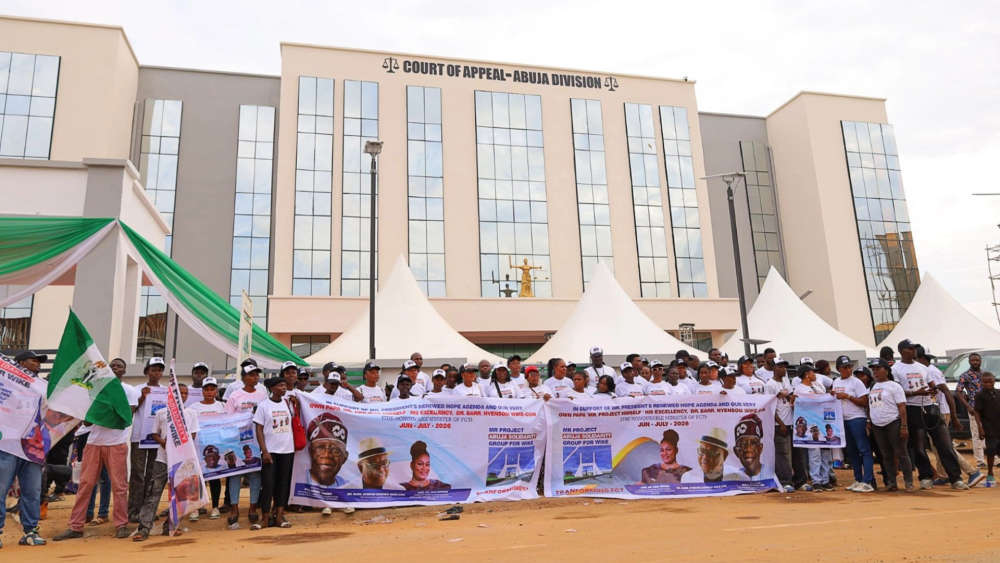
President Bola Tinubu on Monday reaffirmed his administration's commitment to strengthening Nigeria's judiciary, declaring that the rule of law must be supported by modern infrastructure, improved welfare and institutional reforms capable of deepening democracy.
Represented by Vice President Kashim Shettima at the commissioning of the Court of Appeal Abuja Division Building Complex in Daki Biyu, Abuja, Tinubu described the new edifice as a landmark achievement under the Renewed Hope Agenda.
He noted that the construction of the world-class complex demonstrates the government's determination to restore the dignity of key democratic institutions.
The building has two big courtrooms, eight small courtrooms, a library, ten judges' suites, three conference halls, administrative offices with ancillary facilities, among others.
"This is not just a building. This is a statement. A statement that under the Renewed Hope Agenda, the rule of law will have a befitting home," the President said.
He recalled that the Abuja Division of the Court of Appeal had for years operated from a cramped temporary facility, a situation he described as unacceptable for an institution entrusted with dispensing justice.
"A nation that seeks justice must respect the temple of justice. When I visited and saw the condition, I gave a simple instruction: fix it. Today, we have fixed it," he stated.
Tinubu praised the Minister of the Federal Capital Territory, Nyesom Wike, for delivering the project within record time, describing him as "Mr. Project."
"When I appointed you as Minister of the FCT, I knew you would not sleep," he said.
"You promised 16 months. You delivered in record time. No excuses. No variation. Just results. Nigerians can see the difference."
The President urged judges and justices to ensure justice remains swift, fair, and blind to status, ethnicity, or wealth.
The Attorney-General of the Federation and Minister of Justice, Prince Lateef Fagbemi (SAN), described the commissioning as a historic moment for Nigeria's judiciary and democracy, noting that it coincided with the Court of Appeal's 50th anniversary.
"This is not merely the unveiling of a significant judicial edifice. It is a powerful statement of this administration's unwavering commitment to the rule of law, judicial independence, and the strengthening of institutions that safeguard our constitutional democracy," he said.
Fagbemi said President Tinubu had demonstrated unprecedented support for the judiciary through concrete reforms, investments and welfare improvements.
The AGF added that beyond welfare reforms, the administration had embarked on one of the most ambitious judicial infrastructure development programmes in Nigeria's history, including the construction of residences for Court of Appeal justices, Federal High Court judges and FCT High Court judges.
In his remarks, FCT Minister Nyesom Wike revealed that the project was conceived after concerns were raised about the poor state of the Abuja Division and the inadequate accommodation available to judicial officers.
"When I informed Mr. President of the condition of the Court of Appeal, he immediately directed that we should not only provide a befitting complex but also decent accommodation for judges and justices," Wike said.
He disclosed that the FCT Administration had completed or was nearing completion of housing projects for judicial officers across several courts.
The minister argued that judicial independence could not be achieved without adequate infrastructure and conducive working conditions.
The President of the Court of Appeal, Justice Monica Dongban-Mensem, described the new complex as a transformative intervention that would significantly improve the administration of justice.
"The impact of the newly constructed court complex on the administration of justice cannot be overstated. The physical environment in which justice is delivered is a decisive factor that affects the quality, speed, and public confidence in judicial outcomes," she said.
Justice Dongban-Mensem explained that the Abuja Division had long struggled with only two courtrooms and limited administrative space despite handling one of the heaviest caseloads in the country.
She expressed appreciation to the Federal High Court, National Industrial Court, FCT High Court, and Customary Court of Appeal for accommodating the Court of Appeal over the years.

Comments
Add a comment