
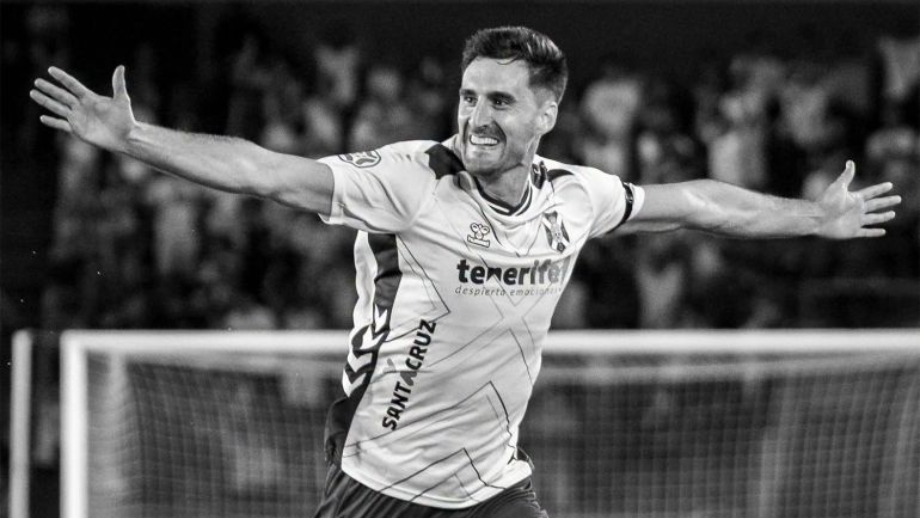
Spanish police have opened an investigation into the death of CD Tenerife striker Jesús de Miguel following a fatal on-field collision with FC Andorra goalkeeper Jesus Owono during a Spanish second-division match.
The investigation is examining whether there could be criminal responsibility, including possible involuntary manslaughter, following the incident that led to the 30-year-old forward's death.
However, prosecutors have indicated that criminal proceedings against Owono are unlikely, as the collision occurred during an active passage of play.
De Miguel died on Tuesday, November 3, a day after suffering a cardiac arrest following the collision during Tenerife's 2-2 draw with Andorra at the Heliodoro Rodríguez Lopez Stadium.
The incident happened in the closing stages of Monday's match when Owono rushed out of his penalty area to challenge for a long ball as De Miguel advanced towards goal.
The Equatorial Guinea international goalkeeper attempted to clear the ball but struck the Tenerife forward in the chest with his knee.
De Miguel immediately collapsed, prompting players from both teams to call for medical assistance.
Medical personnel treated him on the pitch for several minutes before he was taken to hospital by ambulance.
He initially recovered a pulse and was admitted to the intensive care unit at Nuestra Senora de La Candelaria Hospital in Tenerife.
However, his condition later deteriorated, and he died at the age of 30.
Owono was shown a straight red card for the challenge, while the match was abandoned seven minutes into stoppage time.
Following De Miguel's death, Spain's National Police, through its Homicide Group, opened an investigation.
The case is also under judicial supervision, with prosecutors requesting the police report and relevant medical findings to establish the circumstances surrounding the incident.
The investigation will consider whether the collision was solely a sporting incident or whether there was conduct that could attract criminal responsibility.
José Luis Sánchez-Jáuregui, chief prosecutor in Santa Cruz de Tenerife, told Spanish news agency EFE that it would be difficult for the case to lead to criminal proceedings because the incident occurred during the normal course of play.
He explained that established Spanish Supreme Court doctrine generally treats injuries sustained during sporting activity as non-punishable, except in circumstances such as an intentional assault outside the normal course of play.
The prosecutor said investigators would need to examine the referee's report and the findings of the relevant sporting disciplinary authorities, particularly whether the challenge amounted to dangerous or excessively dangerous play and whether there was any intention to cause harm.
He added that De Miguel's family could challenge the conclusions through a complaint alleging an assault resulting in death.
However, he considered that any potential criminal classification would more likely involve death caused by less serious negligence rather than an intentional killing.
The police investigation does not mean Owono has been found guilty of any offence or that a criminal charge has been established against him.
The incident has also raised questions about the possible sporting consequences for the goalkeeper.
His dismissal during the match could be followed by further disciplinary action, depending on the referee's report and the Spanish Football Federation's assessment of the challenge.
Meanwhile, Owono has reportedly faced abusive messages on social media following the incident, with his Instagram account deactivated.
FC Andorra has expressed its condolences to De Miguel's family and Tenerife, while club president Gerard Pique also paid tribute to the late striker.
De Miguel joined Tenerife from Castellón ahead of the 2025-26 season and scored 11 goals last season.
His death has prompted tributes from clubs, players and football organisations across the world.
UEFA announced that moments of silence would be observed before European matches this week, while the Spanish Football Federation postponed several midweek fixtures following the tragedy.
The incident has once again brought attention to the risks associated with collisions in football and the difficult distinction between an unfortunate sporting accident and conduct that could carry criminal consequences.
For now, investigators are expected to establish the full circumstances of the collision, while the question of whether any individual should face criminal responsibility remains unresolved.

Comments
Add a comment