


Journalists covering climate change should focus on evidence-based responses rather than intentions, promises or technology alone, experts said during a webinar organized by Covering Climate Now on solutions journalism.
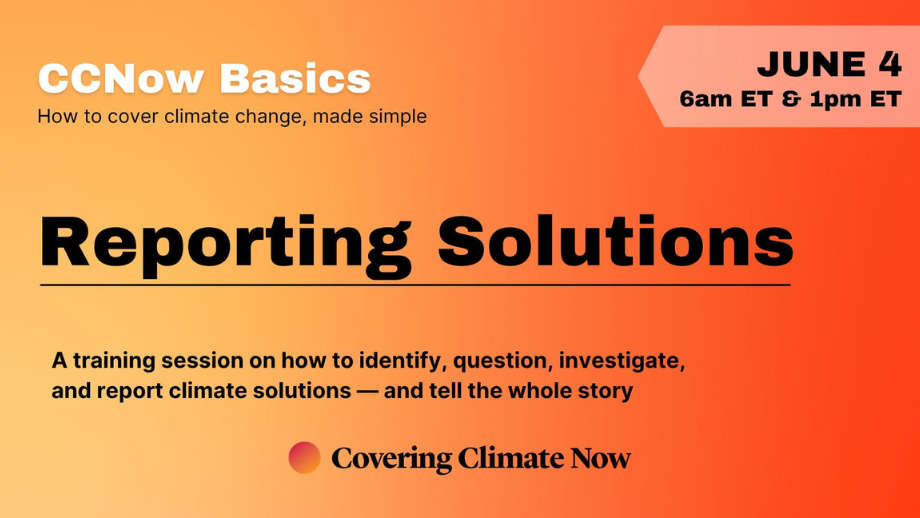
The session, titled "Reporting Solutions (Session 1)," featured climate journalism trainers Elena Gonzalez and Santiago Saez Moreno, who outlined key principles for reporting climate solutions at a time when climate coverage faces growing challenges from policy rollbacks, funding cuts and efforts to undermine scientific research.
"The climate story remains the defining story of our time," the speakers said, stressing that audiences increasingly want reporting that explains not only problems but also what is working, who is making progress and how effective those efforts are.
The presenters cautioned journalists against equating solutions with technology alone, noting that meaningful climate responses can emerge from government policies, business practices, civil society initiatives and cultural interventions.
According to the trainers, effective solutions journalism rests on four pillars: identifying a response to a social problem, providing evidence of results, acknowledging limitations and offering insights that others can learn from.
"Solutions journalism seeks to provide insights that can help others respond, not just inspiration," Moreno said.
Using a Nigeria-based story on climate-resilient agriculture as an example, the speakers demonstrated how solutions reporting can examine the effectiveness of providing drought-resistant crop varieties and farmer education programs in northern Nigeria's Sahel region.
The story showed that improved millet varieties delivered yields about 25% higher than traditional crops while also highlighting challenges and limitations associated with the intervention.
The presenters emphasized that journalists should focus on the action being taken rather than the individuals, organizations or technologies involved.
They also urged reporters to scrutinize climate solutions with the same rigor applied to investigative reporting.
"Nothing is a silver bullet," Gonzalez said. "Every solution has limitations, and journalists have a responsibility to examine those limitations."
The webinar identified five broad categories of climate solutions: politics and government, economics and business, technology, civil society and culture.
Government policies were described as among the most influential drivers of climate action because they shape regulations, taxes, subsidies and investment decisions.
Business practices, consumer behavior, community activism, religious organizations, educational institutions and cultural movements were also highlighted as important areas for solutions-focused reporting.
The experts encouraged journalists to investigate whether corporate climate pledges produce measurable results or amount to greenwashing, and to critically assess the effectiveness of carbon markets, renewable energy initiatives, agricultural adaptation projects and grassroots activism.
The session concluded with a reminder that journalism itself plays a vital role in addressing climate challenges.
Without reliable and evidence-based reporting, the speakers said, communities and policymakers would struggle to identify effective responses to climate change.
"Climate journalism is itself an essential climate solution," Moreno said, urging reporters to continue producing accurate, accountable and impactful coverage.

Comments
Add a comment