

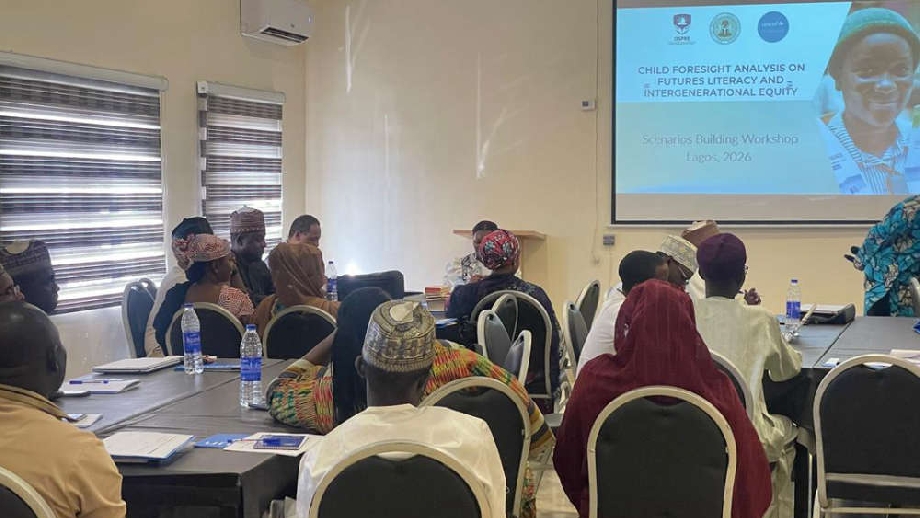
The federal government says it is adopting future-ready national policies to address Nigeria’s growing economic hardship, insecurity, social unrest, education challenges, and climate-related disasters, as part of efforts to build a better future for future generations.
The Special Assistant to the President on Special Duties (National Emergency Management) in the Office of the Vice President, Nigeria, Mohammed Ahmed, disclosed this on Thursday in Kano during a three-day workshop.
The workshop, organised by the Office of the Vice President in partnership with the United Nations Children’s Fund (UNICEF), titled “Anticipatory Governance and Foresight Capacity Programme” and aimed at transforming governance in Nigeria.
Ahmed said the government is shifting from a leadership style that reacts only after crises happen to one that plans and anticipates future risks.
He explained that the move would help Nigeria deal better with complex and fast-changing challenges, while also creating pathways for sustainable growth.
According to him, “the plan is to institutionalise long-term thinking at federal, state and community levels, so that planning is not limited to short political cycles.”
He said findings from the workshop would be harmonised into a single report to guide policy decisions and help shape a better national future by 2050.
The workshop brought together policymakers, development practitioners, thought leaders and technical experts from the North-east, North-west and North-central regions to examine how future thinking can be built into Nigeria’s long-term governance strategies.
Participants discussed how strategic foresight can support national planning in areas such as security, education, the economy, climate change and social protection.
In Nigeria’s increasingly complex and multidimensional threat environment, speakers at the event said the demand for a shift from reactive crisis management to anticipatory governance is becoming stronger.
They described strategic foresight as a forward-looking and participatory approach that enables leaders to better understand uncertainty, identify emerging risks early and design policies that can withstand future shocks.
A facilitator at the workshop, Dr Katindi Sivi, challenged public officials to move away from short-term responses and begin to build long-term strategic frameworks.
She said strategic planning should not focus on predicting exactly what will happen in the future but on preparing for different possible futures.
“Strategic planning is not about predicting the future. It is about preparing for multiple futures,” she said.
Dr Sivi explained that leaders must use tools such as environmental scanning, scenario development, trend analysis and backcasting to better understand risks and opportunities.
According to her, strategic foresight allows governments to anticipate disruptions, align policies with emerging threats and strengthen their ability to adapt to change.
Also speaking at the workshop, a planning specialist with UNICEF Nigeria, Boco Abdul, said the programme is timely, especially as Nigeria plans for the future of children up to the year 2050.
She said “the initiative is designed to strengthen government systems, structures, policies and programmes, particularly in areas that directly affect children and young people.”
According to her, “data have already been gathered on issues that are likely to shape the lives of children in the future, including employment, artificial intelligence, climate change and access to quality education.”
Boco said these trends would have serious long-term implications for children if governments fail to respond early.
She added that the main goal is to address future challenges in a sustainable way and ensure that public policies protect children and promote their development.
“The outcome of this workshop will help improve government policies and planning,” she said.
She noted that future-focused planning is critical for building resilient institutions that can support children and families in an uncertain global environment.
A participant at the workshop and head of the Health, Safety and Environment Unit at the Nigeria Social Insurance Trust Fund, Mustapha Usman Salisu, commended the initiative and described it as a necessary step towards safer and more inclusive governance.
Salisu said “Placing stronger emphasis on child protection and youth participation in governance would help address the root causes of crime and social instability in the future.”
He stressed that “young people must be meaningfully involved in decision-making processes if Nigeria hopes to build peaceful and productive communities.”
According to him, the foresight programme is not only about solving today’s problems but also about preparing leaders and institutions for uncertainties that may arise in the coming decades.
“This programme is about building capacity, not just for today’s problems, but for tomorrow’s uncertainties,” he said.